
Lilly Zar, a Rebel with plenty of cause.
We met in a boutique hotel in London’s Mayfair, the kind of place where the atmosphere carries a jarring mix of formality and intrigue - a strange balance which felt instinctively aligned with Lilly Zar itself. I make a point of asking my interviewees to choose the setting for a first meeting, as it often reveals more than the conversation itself, and this choice spoke volumes. It is here, tucked just out of view from the street, that Lilly arrives as something of a disruption to the setting. There is nothing incidental about her presence. She wears a custom Lilly Zar piece, cut with precision and layered with the brand’s now-signature details. The complicated silhouette holds structure, and moves with ease, and when she shifts, the detail of the lining catches the light, offering a glimpse into the internal world she speaks about so often. It is storytelling, and it is theatre quite literally, beneath the surface. There is a forceful energy about her entrance, the way she interacts with the hotel staff and how she holds herself in the room - you certainly feel that she has ‘arrived’. She is, unmistakably, a sight to behold.
There is a sense, immediately, that she does not belong to the traditional rhythm of the fashion industry. Not because she sits outside of it, but because she seems to have more control over her direction more than most. She has made her own rules, without capitulation to investors, known fashion houses or special interests. In a landscape defined by speed, replication, and saturation, Lilly is building something more deliberate, more resistant to trend. An emerging voice, though not a tentative one, there is determination and intention in every decision made, and every small detail implemented. Curious? I’d say so. Unconventional? Yes. Maverick? Most definitely.
“I don’t really believe in creating for the sake of creating,” she says, settling into the conversation with directness. “For me, it has to mean something. It has to last.”
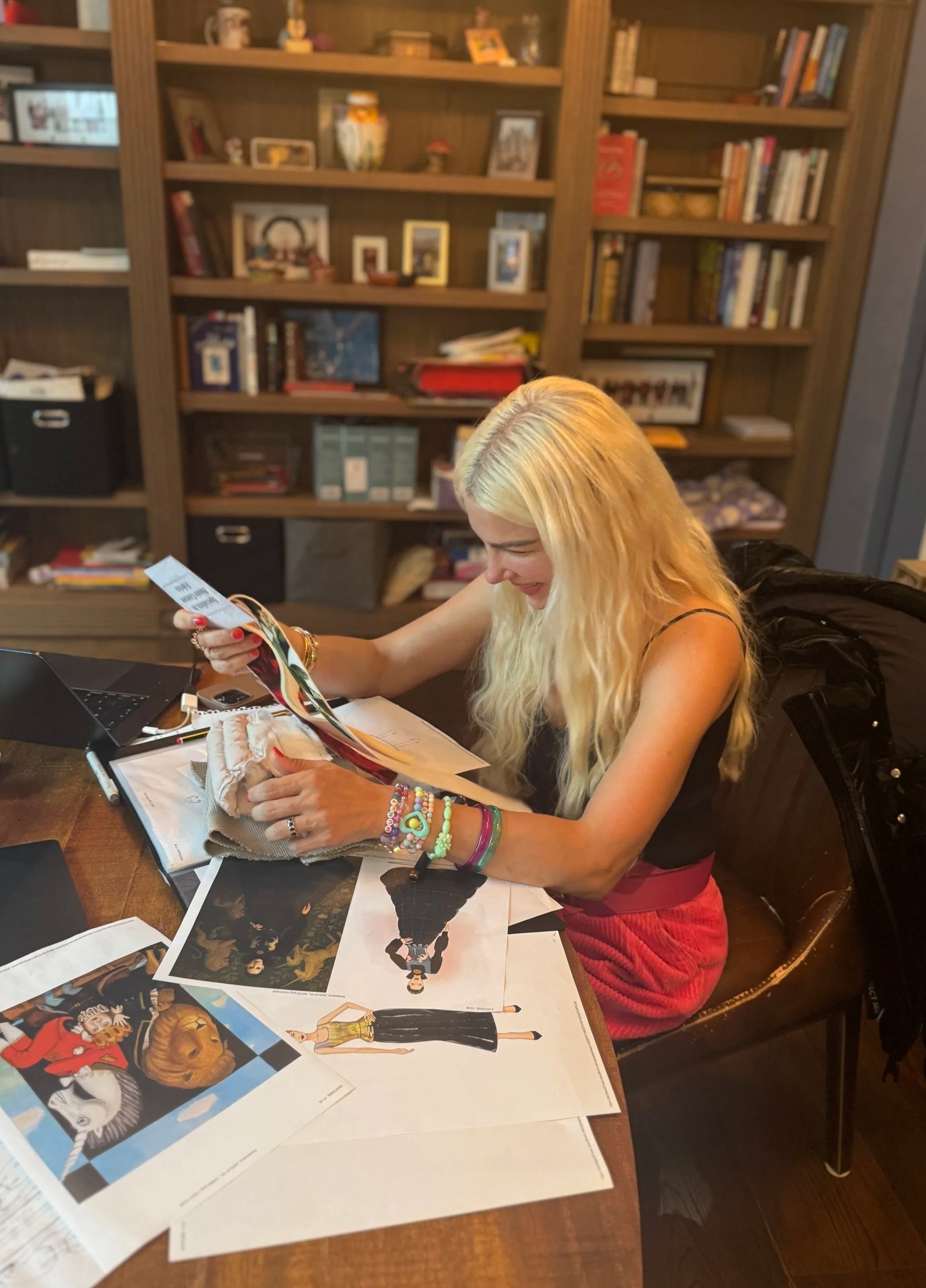
Early stage development.
This idea of longevity surfaces quickly, though it is framed less as strategy and more as instinct. When asked what first led her to consider clothing as collectible, her answer moves away from industry logic entirely.
“I love the idea of legacy and heritage,” she explains. “As a mother, I always think about what I will leave behind for my kids, how they will remember me. I hate wastage. I really believe in creating things you can hold dear, something you feel proud to pass on.”
It is a perspective that reframes value, shifting it from seasonal relevance to generational significance. In Lilly’s world, a garment is not simply owned, it is carried forward. This belief underpins Lilly Zar’s positioning as wearable art, a term she approaches with intention rather than abstraction.
“Real fashion reflects who you are without words,” she says. “Someone can pass you on the street and have a sense of you just from your style. The way you wear something, the way it moves, it tells your story.”
She pauses briefly, then adds, “Clothing is an art. Your style is your art. When the two come together, that’s when something real happens.”
There is a particular emphasis on construction, on the unseen elements that shape the experience of wearing a piece. She returns often to the lining, a detail she considers essential rather than supplementary.
“The lining is so important,” she says. “It’s overlooked, but it carries so much potential. I’ve really enjoyed placing storytelling there, not just on the outside of the garment, but within it.”
This attention to inner detail mirrors her broader approach to design, one that is rooted in time rather than trend. Lilly speaks of studying garments historically, tracing their evolution across decades, sometimes centuries, before reinterpreting them through a contemporary lens.
“I love timeless pieces,” she explains. “I look at craftsmanship from the past and think about how it can exist now, and still exist in fifty years. It’s about creating something that feels relevant across time.”
The comparison to enduring fashion icons arises naturally in conversation, and she nods to the idea of pieces that hold their place across generations.
“It’s like a classic Chanel jacket,” she says. “There’s a reason it stays. That’s what I’m interested in.”
What, then, makes a garment worth keeping?
“For me, it’s the design and the quality,” she says. “It has to resonate over time. It has to feel just as strong years later as it did when you first saw it.”
Narrative, however, is what gives that resonance depth. Each piece begins with research, often grounded in historical references that are then reworked and adapted.
“I’m a total sucker for history,” she admits, with a smile. “I love stories. Before I design anything, I study how that piece has evolved. I look at how it’s changed through the centuries, and then I build from there.”
The result is clothing that carries a sense of continuity, garments that feel connected to something larger than themselves. Yet they are not complete without the wearer.
“I always imagine the person who will wear it,” she says. “What they love, what they do, why they would choose that piece. Would I wear it? Why would I buy it? That’s how I shape the design.”
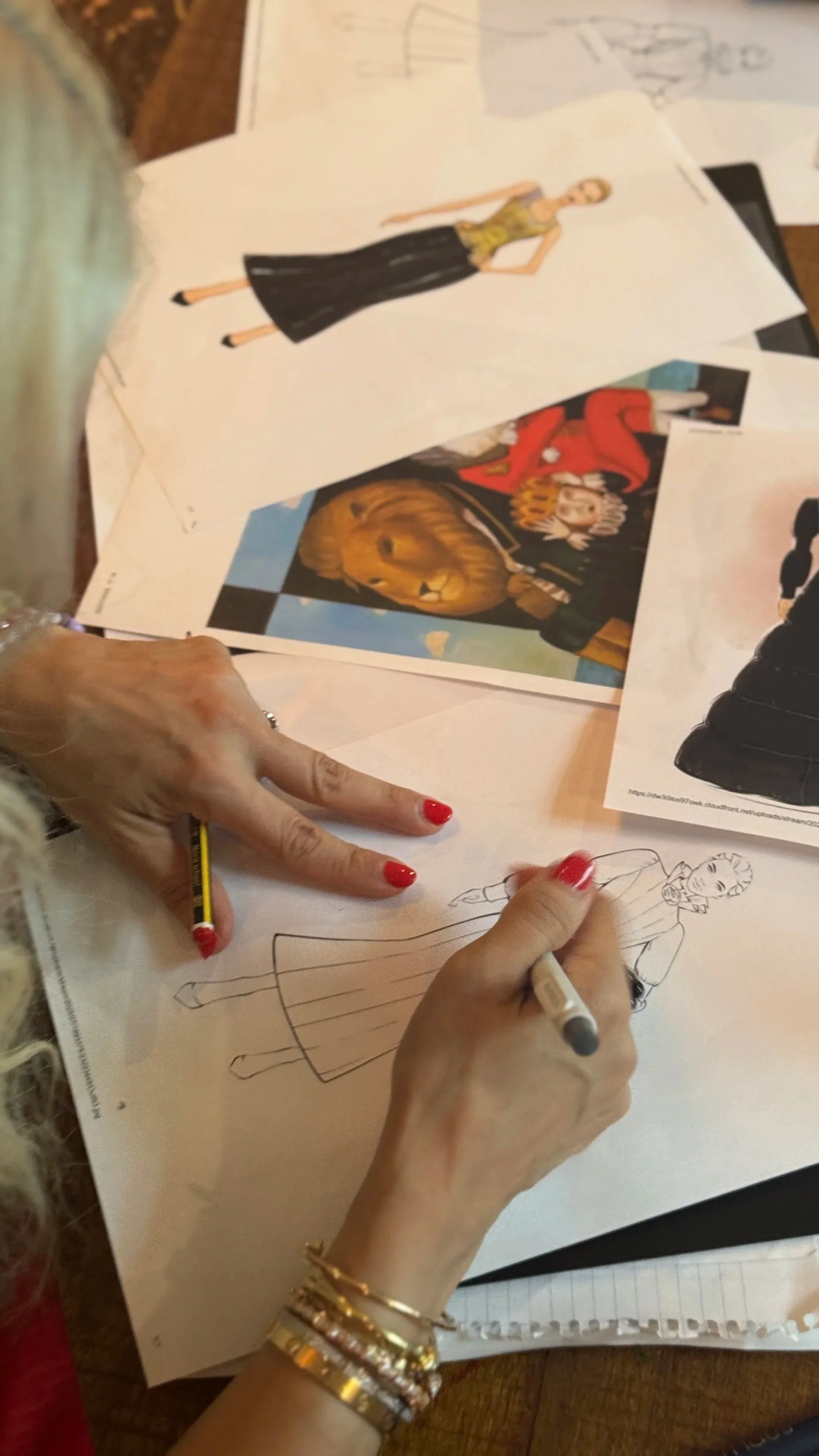
There is an understanding here that clothing does not exist in isolation. It is activated through use, through movement, through context, and by developing technology. The wearer becomes part of the work, whether consciously or not.
This awareness extends into her thinking around building value as a new brand. Lilly acknowledges the competitive nature of an industry saturated with genuine talent and output - where distinction is essential and visibility can be difficult to secure.
“It is very competitive,” she acknowledges. “There are so many talented designers. For me, it’s about creating something unique enough, something beautiful enough, that people are willing to take that chance.”
Technology, inevitably, enters the conversation, though Lilly approaches it with curiosity rather than caution. She speaks about the potential for digital and physical worlds to intersect, creating new layers of collectability and engagement.
Lilly Zar moves with a distinct point of view, approaching clothing as something to be collected and invested in, much like art itself. In doing so, the brand begins to shape a new cultural stream, one where garments are tracked, interpreted, and understood beyond wear. Early conversations around a wearable art and technology trend report signal a fresh proposition, introducing a way of seeing fashion that feels both deliberate and subtly disruptive within the current market.
“With AI and how fast everything is moving, I think it’s important to bring those worlds together,” she says. “I’ve been exploring ways to connect garments with digital spaces, through avatars, through collectible elements. It adds another dimension to how people experience the work.”
It is a perspective that aligns with Lilly Zar’s broader positioning, situated somewhere between fashion, art, and emerging technology. A brand that does not sit comfortably within a single category, and does not seem particularly interested in doing so.
As the conversation draws to a close, the focus returns, once again, to the wearer. Not as consumer, but as custodian.
“I want each piece to feel like an investment,” Lilly says. “Something that stays with you. Something that becomes part of your life, and maybe even something you pass on.”
In a market driven by immediacy, it is a radical proposition. A slower fashion, though not in pace alone, in intention. One that resists disappearance and insists on staying.
She teases the recent and explosive launch of Lilly XR, her extended reality world that continues the Lilly Zar story beyond the physical garment, opening it into something more expansive and more immersive. A new dimension begins to take shape, one that feels as much like a cultural space as it does a digital one.
But our time together is slipping away. She gathers her things before heading across London for her weekly meeting with her manufacturer. Another hotel, another conversation, perhaps. This is a name to keep close.
